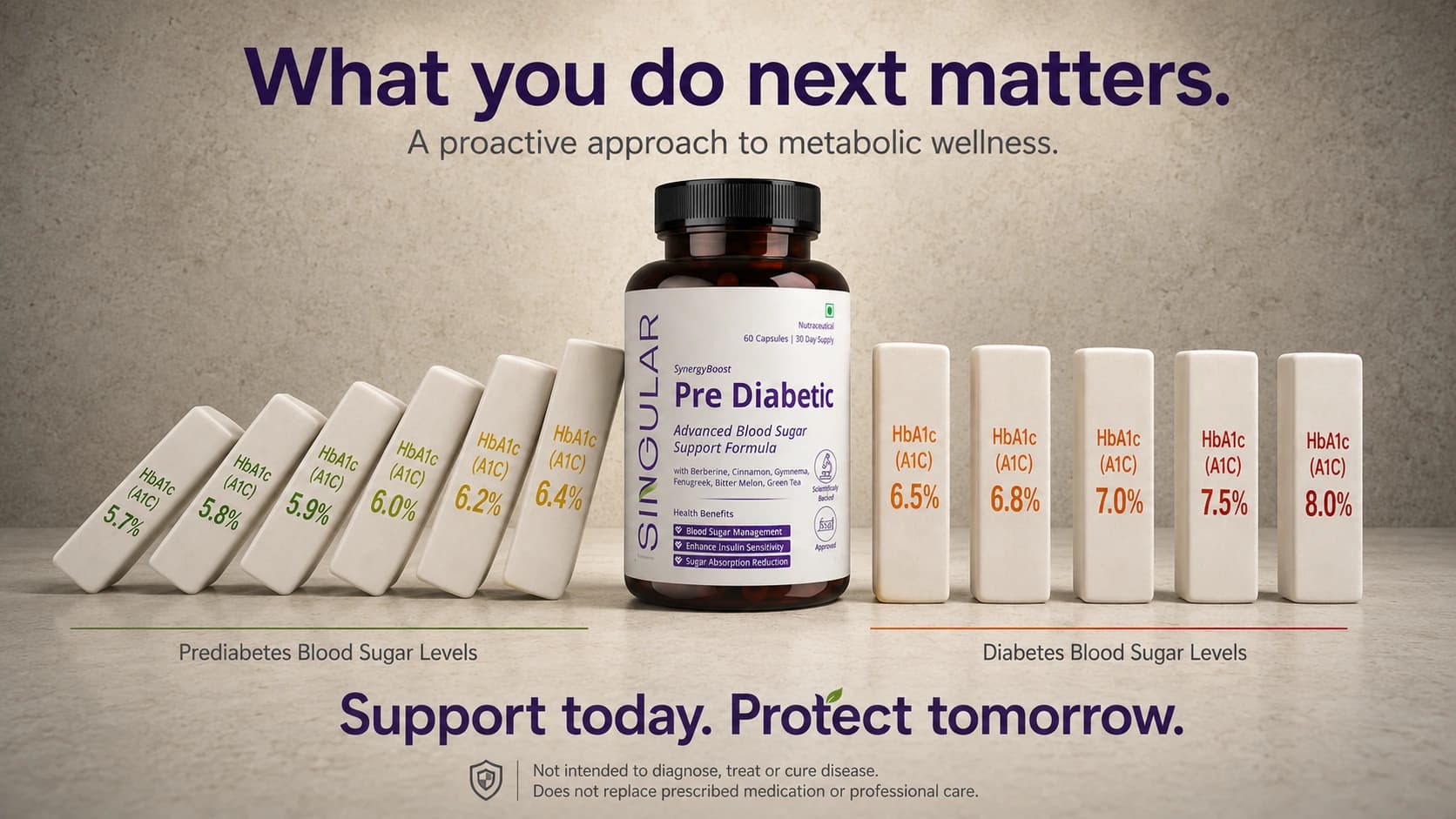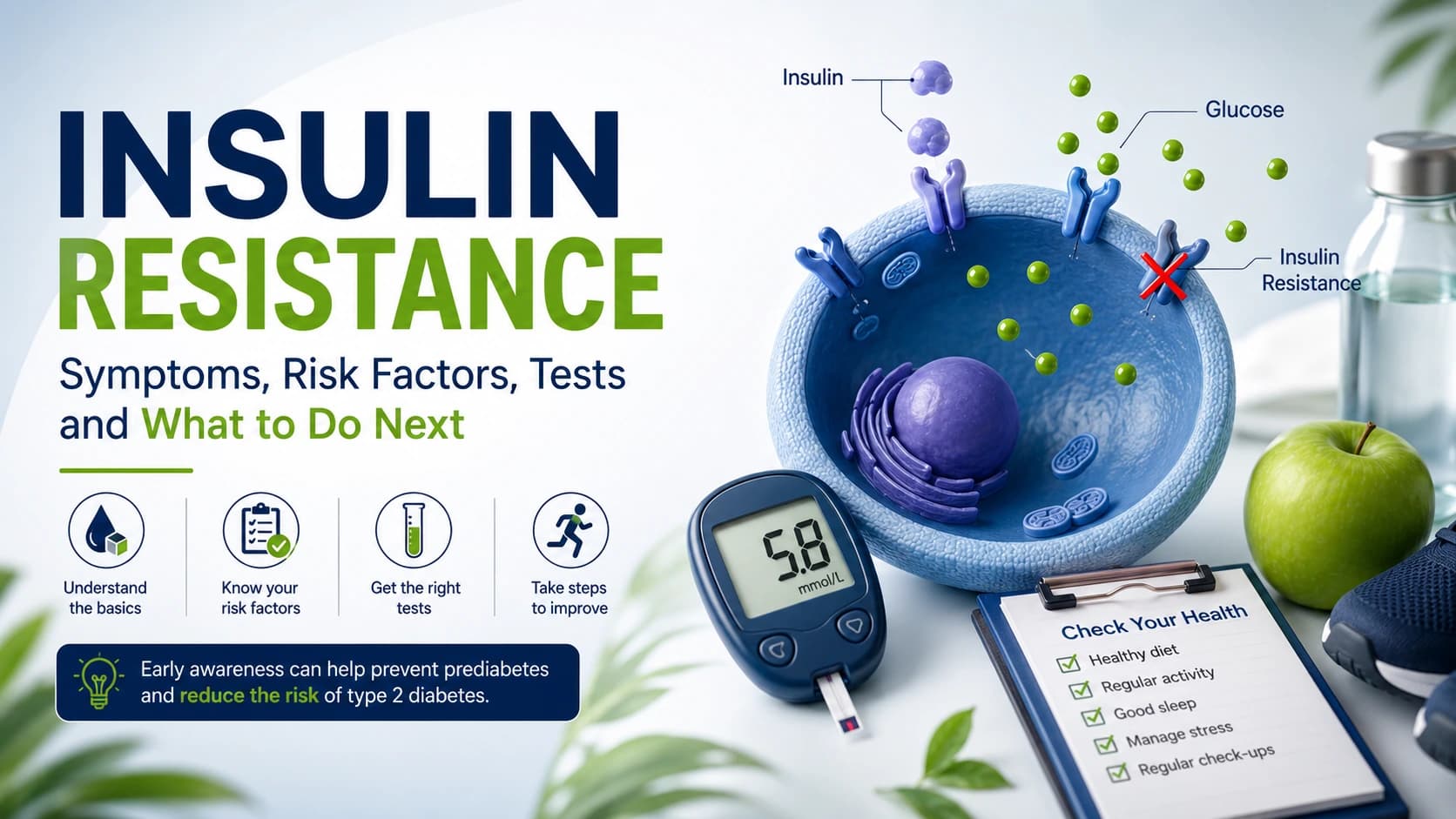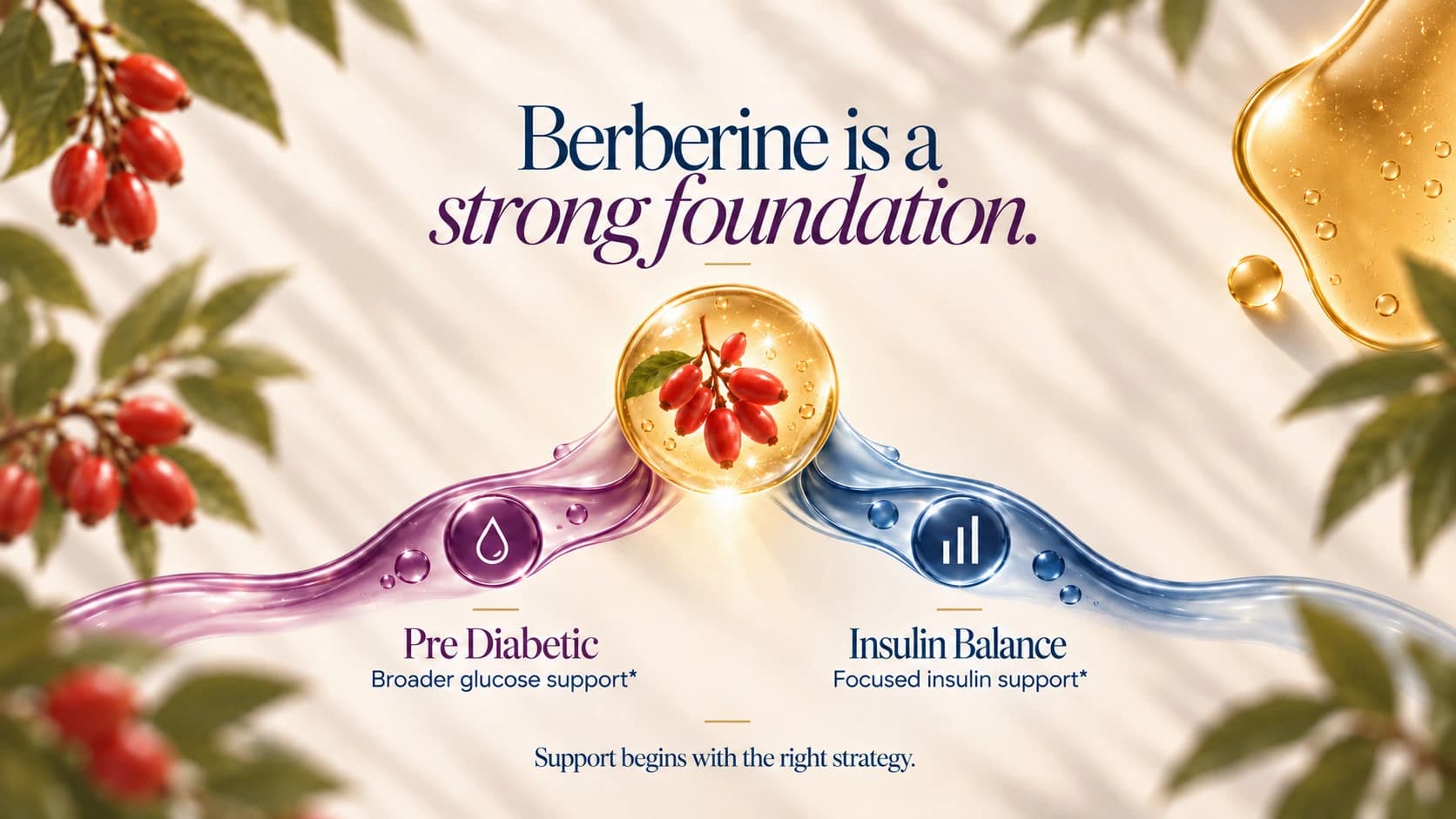
Why the formula around berberine matters for broader glucose support and focused insulin-sensitivity support.
If you are searching for berberine for prediabetes, insulin sensitivity, insulin resistance, blood sugar support or post-meal glucose spikes, you have probably seen hundreds of products built around one message: Take Berberine.
There is good reason Berberine has received so much attention. An umbrella meta-analysis of randomized trials reported improvements across fasting glucose, HbA1c, fasting insulin and HOMA-IR in studied populations with metabolic disorders. The authors also noted inconsistency between underlying studies, which is important when interpreting the evidence.1
So Singular’s does not reject the Berberine trend. We start with it.
Berberine is the foundation.
The more interesting question is what should surround that foundation. Because glucose metabolism is not controlled by one biological process. It involves carbohydrate handling, the glucose rise after meals, insulin signaling, cellular glucose utilization and the wider metabolic environment.
Instead of asking only “How much Berberine?”, ask “What is working with the Berberine?”
That is the thinking behind the Singular’s SynergyBoost approach.
Why Berberine Has Become So Popular for Metabolic Health
Berberine is an isoquinoline alkaloid naturally found in botanical species including Berberis.
Unlike a simple vitamin deficiency model, Berberine has been studied across several metabolic mechanisms. Clinical research has investigated its relationship with glucose regulation, insulin resistance, lipid metabolism and inflammatory markers.
The 2024 umbrella meta-analysis by Nazari and colleagues found statistically significant effects across several glycemic outcomes, including fasting glucose, HbA1c, insulin and HOMA-IR.1
That makes Berberine a logical ingredient to place at the center of a metabolic-support formula.
A strong ingredient is not the same thing as a complete formulation strategy.
Your Metabolism Does Not Work Through One Pathway
Imagine what happens after a carbohydrate-containing meal. Food is digested. Carbohydrates are broken down. Glucose enters circulation. Insulin signaling responds. Muscle and other tissues need to handle circulating glucose. Cells use glucose within broader energy metabolism.
All of those processes are connected. That is why metabolic-health research often measures several different outcomes rather than just one number: fasting glucose, postprandial glucose, HbA1c, fasting insulin and HOMA-IR.
So if your real goal is broader glucose support or focused insulin-sensitivity support, there is a scientific rationale for looking beyond a single isolated ingredient.
What “Synergy” Actually Means in Botanical Science
“Synergy” should not mean simply putting many ingredients into one capsule.
In pharmacognosy and phytomedicine, synergy describes interactions in which multiple constituents can act together in ways that differ from considering each compound independently. Williamson’s widely cited review in Phytomedicine describes synergistic and other interactions as an important part of understanding multi-constituent botanical preparations.2
This gives us a useful formulation principle: different ingredients can contribute different biological roles toward the same overall metabolic objective.
That does not prove that every ingredient combination is synergistic, and it does not prove that a finished Singular’s formula is clinically more effective than Berberine alone. A head-to-head trial of the actual finished formula would be needed to establish that.
Berberine is the foundation. Complementary multi-pathway support is the strategy.
Why Add Other Ingredients to Berberine?
Because they are not all being asked to do the same job.
A well-designed metabolic blend can combine ingredients studied across different aspects of glucose and insulin physiology. That gives the formulation a wider biological architecture than simply increasing the dose of one ingredient.
Consider some of the ingredients used across Singular’s formulations.
Gymnema: A Complementary Glucose-Support Botanical
Gymnema sylvestre has a long history of traditional use and has also been studied clinically. A systematic review and meta-analysis involving 10 studies and 419 participants reported reductions in fasting glucose, postprandial glucose and HbA1c following Gymnema supplementation.3 However, heterogeneity across the included studies was substantial, so the findings should not be interpreted as proof of a predictable effect in every person. From a formulation perspective, Gymnema is relevant because it creates another layer of support around glucose handling and post-meal metabolism. That complements rather than replaces Berberine.
Cinnamon: Another Pathway Around Glucose and Insulin
Cinnamon is one of the most researched botanicals used in glucose-support supplements. An updated systematic review and meta-analysis of randomized controlled trials found statistically significant improvements in fasting glucose, HbA1c and HOMA-IR among participants with type 2 diabetes, although trial differences and heterogeneity remain important limitations.4 This gives cinnamon a logical place in a formulation intended to address glucose metabolism from more than one angle. The more defensible statement is: Cinnamon adds another complementary evidence-backed metabolic pathway to the formulation.
Fenugreek: Especially Relevant to Post-Meal Glucose
Fenugreek has particular relevance to the post-meal glucose conversation. An updated meta-analysis of randomized controlled trials reported improvements in fasting glucose, two-hour postprandial glucose, HbA1c and insulin.5 The authors also reported high heterogeneity for several outcomes and called for better-quality studies. Another systematic review focusing on type 2 diabetes and prediabetes similarly reported improvements in fasting glucose, two-hour glucose and HbA1c, while not finding a significant reduction in HOMA-IR.6 That distinction illustrates exactly why multi-pathway formulation is useful conceptually. Different ingredients do not need identical effects. They can contribute to different parts of the metabolic picture.
Bitter Melon: Evidence Has Strengthened
Bitter melon (Momordica charantia) is another traditional metabolic-health botanical. A 2025 GRADE-adherent meta-analysis of randomized controlled trials in people with prediabetes or type 2 diabetes reported reductions in fasting glucose, HbA1c, insulin and HOMA-IR.7 That makes bitter melon particularly relevant to a formula positioned around broader glucose-metabolism support.
Magnesium and Chromium: The Nutrient Side of the Strategy
A metabolic formula does not have to rely entirely on botanicals. Magnesium plays physiological roles related to insulin signaling and glucose metabolism. A systematic review and meta-analysis of randomized trials found that magnesium supplementation improved HOMA-IR overall, with longer interventions showing greater effects on fasting glucose and insulin-resistance measures.8 Chromium has also been investigated extensively. A meta-analysis of 28 studies in participants with type 2 diabetes reported improvements in fasting glucose, HbA1c, insulin and HOMA-IR, although heterogeneity was high.9 These nutrients therefore create another formulation layer around insulin and glucose metabolism.
Alpha-Lipoic Acid: Useful, but the Evidence Needs Nuance
Alpha-lipoic acid, or ALA, is often discussed in relation to antioxidant activity, mitochondrial metabolism and insulin sensitivity. The clinical evidence is mixed. A systematic review and dose-response meta-analysis found effects on some glycemic markers, while another meta-analysis in uncomplicated type 2 diabetes did not find significant benefits for HbA1c, fasting glucose or postprandial glucose.10 That is exactly why ALA should not be marketed as a stand-alone solution. Its more defensible role in Singular’s is as one component of a broader cellular-metabolism and insulin-support architecture.
Curcuma, Green Tea and Garlic Add Additional Metabolic Context
Curcumin has human clinical evidence in people with prediabetes. A randomized, double-blind, placebo-controlled trial involving 240 people with prediabetes reported differences in diabetes progression, beta-cell measures and HOMA-IR over nine months.11 It remains one study, so it should not be generalized beyond the population and intervention studied. Green tea has also been evaluated in randomized trials. A 2020 meta-analysis of 27 trials found a small reduction in fasting glucose but no statistically significant effects on fasting insulin or HbA1c.12 Garlic has more recent evidence. A 2026 GRADE-assessed meta-analysis of 27 randomized trials reported modest reductions in fasting glucose and HbA1c, while insulin and HOMA-IR did not change significantly.13 Once again, these different findings support the same formulation philosophy: Different ingredients can play different roles.
One Berberine Foundation. Two Different Metabolic Concerns.
This is why Singular’s does not use one identical “Berberine formula” for everyone. The two SynergyBoost products start from the same broader philosophy but emphasize different metabolic priorities.
| Comparison | Singular’s Pre Diabetic | Singular’s Insulin Balance |
|---|---|---|
| Core concept | Broader glucose support | Focused insulin support |
| Berberine | 97% Berberine HCl positioning | 97% Berberine HCl positioning |
| Main goal | Broader multi-pathway metabolic support | Greater emphasis around insulin sensitivity |
| Complementary ingredients | Cinnamon, Gymnema, Fenugreek, Bitter Melon, Green Tea, Curcuma, ALA, Garlic, Magnesium, Chromium and Piperine | Gymnema, ALA, Magnesium, Fenugreek, Cinnamon, Curcuma, Chromium and Piperine |
| Consumer search intent | Berberine for prediabetes, post-meal glucose, blood sugar support | Berberine for insulin resistance, insulin sensitivity, glucose metabolism |
Neither formula should be understood as a treatment for diabetes or prediabetes. They are nutraceutical formulations designed around different nutritional-support priorities.
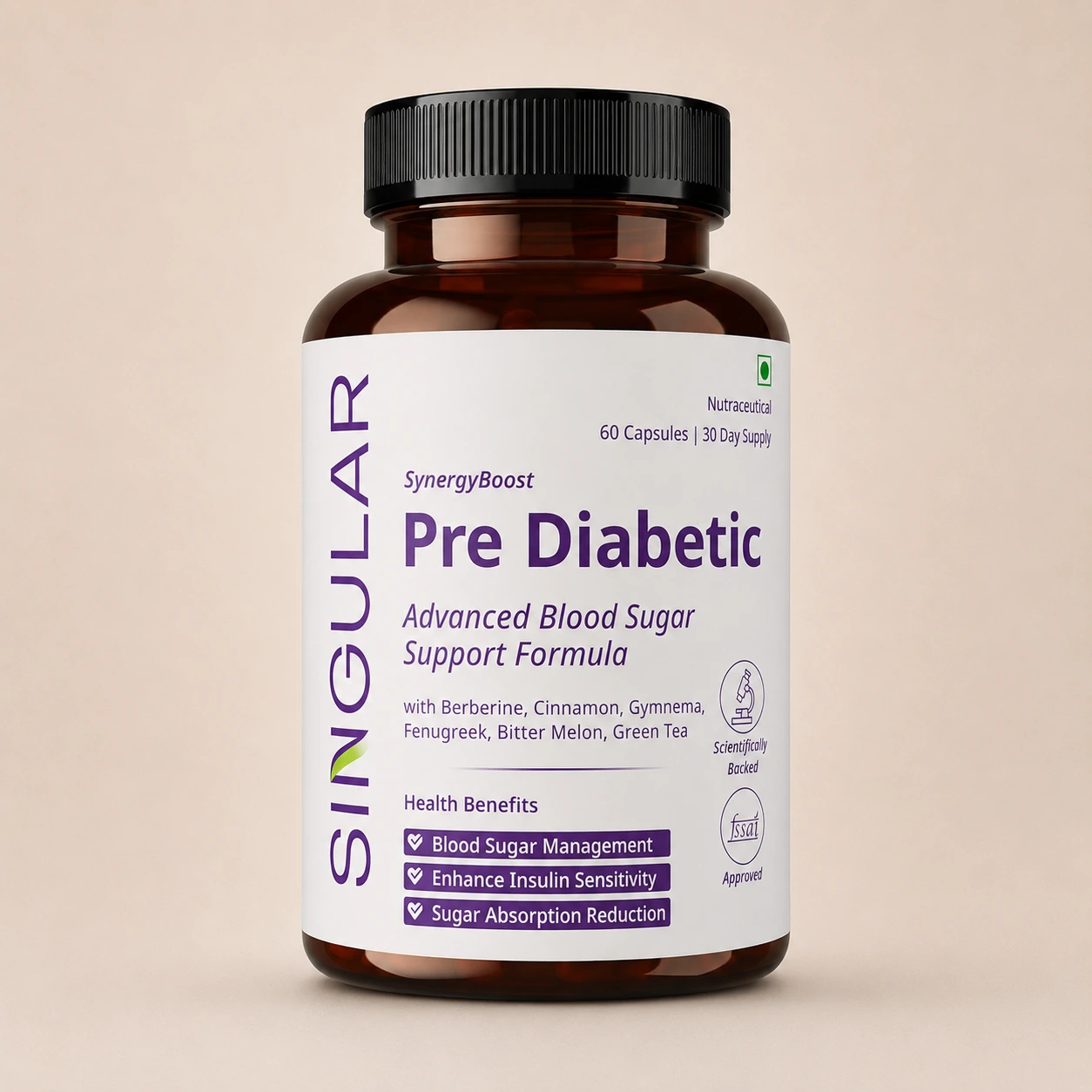
Singular’s Pre Diabetic: When Your Concern Is Broader Than One Number
Someone searching online for “berberine for prediabetes” may actually have several concerns: fasting glucose, post-meal glucose, HbA1c, family history, or a general desire for nutritional support before metabolic markers move further in the wrong direction.
That is a broad concern. Singular’s Pre Diabetic is therefore built around broader pathway coverage.
Berberine provides the foundation. Gymnema, Cinnamon and Fenugreek extend the glucose and post-meal story. Bitter Melon adds another glucose-metabolism botanical. Magnesium and Chromium contribute nutrient-based metabolic support. Curcuma, Green Tea, Garlic and ALA broaden the wider metabolic and antioxidant architecture.
For someone currently considering a plain Berberine supplement because they are concerned about overall glucose metabolism, Singular’s Pre Diabetic gives them a more targeted formulation to compare before purchasing.
When the concern is broader, the support strategy should be broader too.
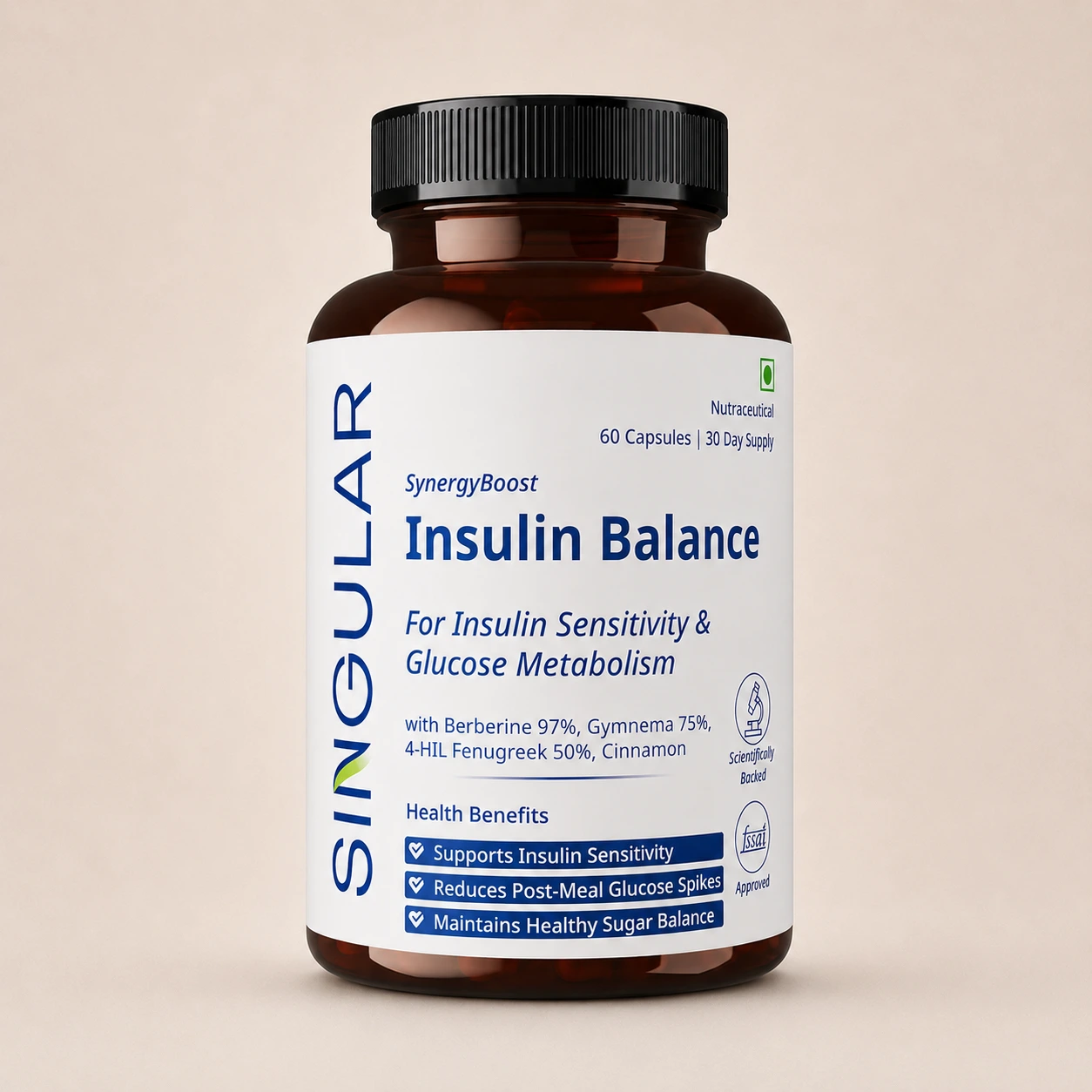
Singular’s Insulin Balance: When Insulin Sensitivity Is the Priority
A different person may be searching “Berberine for insulin resistance,” “Best Berberine for insulin sensitivity,” “Why do I get glucose spikes after meals?” or “Supplements for insulin sensitivity.” That is a more focused concern.
Singular’s Insulin Balance places greater emphasis around the insulin-sensitivity and cellular-metabolism story.
Its formulation combines the Berberine foundation with higher Gymnema and ALA emphasis, together with Magnesium, Fenugreek, Cinnamon, Chromium, Curcuma and Piperine.
The goal is not to simply add ingredients. It is to organize complementary ingredients around the concern. For consumers currently considering Berberine primarily because they are researching insulin sensitivity or glucose utilization, this is the formula to compare.
When insulin response is the priority, focus the formulation around insulin-related pathways.
Should You Switch From Berberine Alone?
Not automatically. A simple Berberine supplement may be perfectly reasonable for someone who specifically wants Berberine and is using it appropriately.
The argument for a multi-ingredient product is different.
If your goal is the ingredient, choose the ingredient. If your goal is the metabolic concern, compare the formulation.
That distinction is more useful than claiming that one product is automatically “stronger.”
If your concern is broader glucose metabolism, compare Singular’s Pre Diabetic. If your concern is insulin sensitivity and insulin response, compare Singular’s Insulin Balance.
Both keep Berberine at the center. What changes is the support system around it.
Berberine Is the Foundation. Synergy Is the Strategy.
Berberine deserves its popularity. The scientific literature gives consumers legitimate reasons to be interested in it.
But metabolism is interconnected. Glucose handling, post-meal glucose response, insulin sensitivity and cellular metabolism do not operate as isolated pathways.
That is why the next generation of Berberine supplementation does not necessarily need to abandon Berberine. It can build intelligently around it.
One foundation. Two concern-specific strategies.
Frequently Asked Questions
Is Berberine effective for blood sugar?
Meta-analyses of randomized studies suggest Berberine can improve several glycemic markers in studied metabolic populations, including fasting glucose, HbA1c and insulin-resistance measures. Results vary among trials and should not be interpreted as a guaranteed individual effect.
Does Berberine help insulin sensitivity?
Research has reported improvements in HOMA-IR and insulin-related outcomes in some studied populations, although study quality and formulations vary.
Can Berberine help post-meal glucose?
Berberine has been studied in glycemic control, but post-meal metabolism involves multiple processes. Ingredients such as Gymnema and Fenugreek also have clinical literature relating to postprandial glucose.
Is Berberine with Cinnamon better than Berberine alone?
There is evidence for Berberine and Cinnamon individually, but that does not prove that the combination is clinically superior to Berberine alone. A study directly comparing the finished combination against Berberine alone would be needed to make that claim.
Why combine Berberine with Gymnema, Fenugreek and minerals?
The rationale is complementary pathway coverage. Gymnema, Fenugreek, Magnesium, Chromium and other ingredients have been investigated for different glucose- and insulin-related outcomes. The goal is a broader formulation architecture rather than simply adding more ingredients.
Which Singular’s formula should I choose?
Singular’s Pre Diabetic is positioned around broader glucose-metabolism support, while Insulin Balance is positioned around more focused insulin-sensitivity support. If you have diagnosed prediabetes, diabetes, take glucose-lowering medication or experience repeated abnormal glucose readings, product choice should be discussed with a qualified healthcare professional rather than relying solely on supplements.