SINGULAR WELLNESS PRIVATE LIMITED
SCIENTIFIC REVIEW
The physiology of its 12 ingredients in prediabetes
| 01 | 02 | 03 | 04 |
|---|---|---|---|
| MEAL | INSULIN | LIVER | MUSCLE |
EVIDENCE SCOPE
This review summarizes research on individual ingredients. Studies often use different preparations and doses from this product.
| AUTHOR | DOCUMENT CONTROL |
|---|---|
| Dharmesh Raval | Co-Founder | SW-SR-01 | Version 1.0 |
| Singular Wellness Private Limited | 21 October 2026 |
Company-authored educational review. It is not a clinical trial report or medical advice.
How Singular Pre Diabetic Works: The Physiology of Its 12 Ingredients in Prediabetes
21 October 2026
By Dharmesh Raval, Co-Founder, Singular Wellness Private Limited
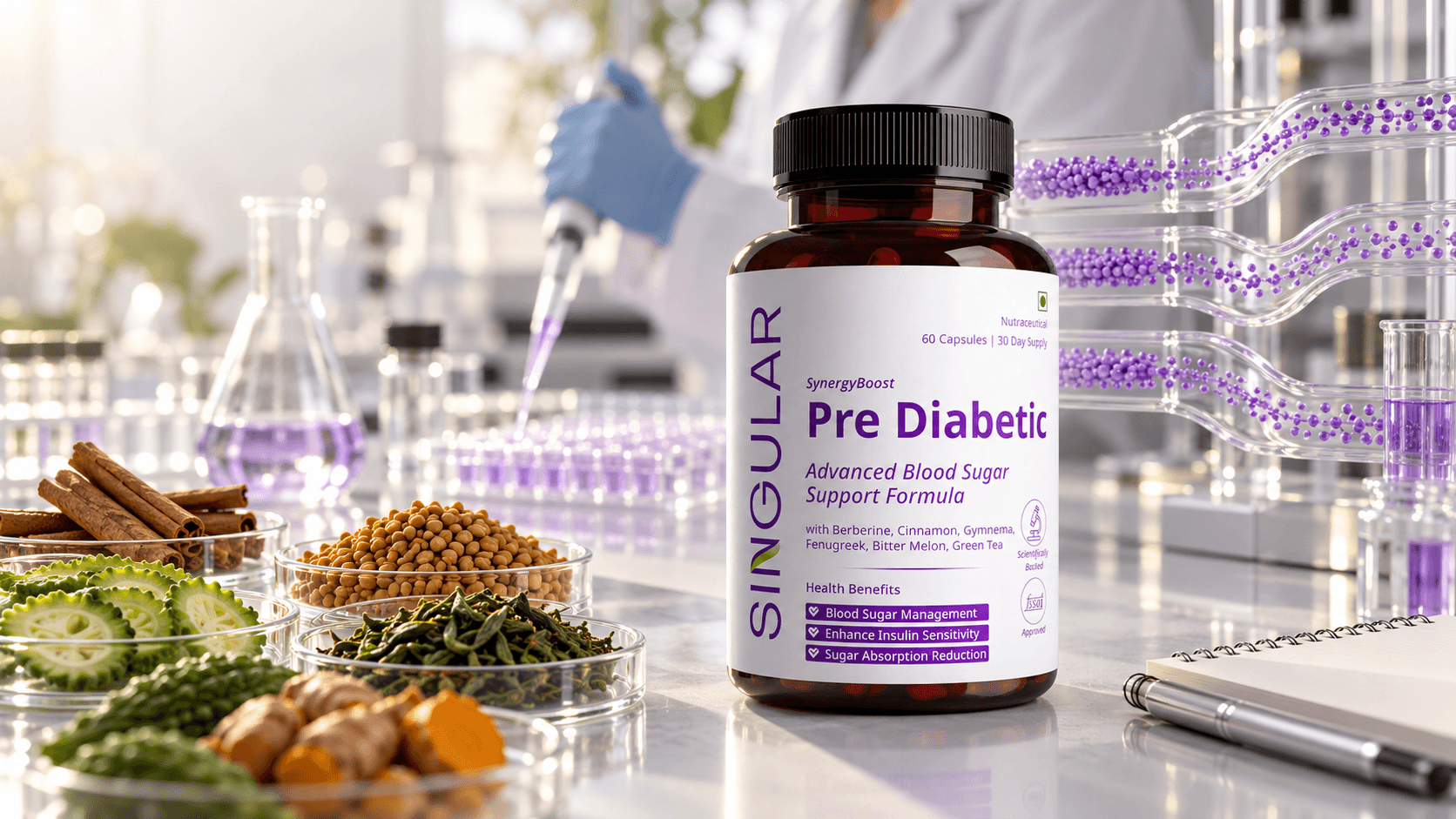
Singular Pre Diabetic is a 12-ingredient nutraceutical taken as two capsules a day1. Its ingredients were chosen to act at the four points where glucose control slips in prediabetes: glucose arriving from meals, the early insulin response, glucose released by the liver, and glucose uptake into muscle. This article explains the physiology of each step and how each ingredient is thought to act on it.
Each ingredient has been studied on its own, mostly in laboratory, animal or small human studies and at doses different from this product's. See the companion article, Singular Pre Diabetic and Glucose Disposal: What Does the Science Say?.
Key Points
- Prediabetes is four linked problems, not one. The liver releases too much glucose, the early insulin response to meals is weak, muscle takes up glucose slowly, and the insulin-making beta cells come under strain2, 3.
- The ingredients are grouped by where they act. Gymnema, fenugreek and cinnamon at the meal; fenugreek's 4-hydroxyisoleucine at the insulin response; berberine and curcumin at the liver; alpha-lipoic acid, chromium, cinnamon, magnesium, berberine, bitter melon and green tea at muscle.
- Muscle has two ways to take in glucose. Insulin resistance blunts the insulin route, but the route used by exercise still moves the GLUT4 transporter to the muscle surface4, 5. The formulation includes ingredients studied on each route.
- Some ingredients support others. Piperine raised curcumin absorption 20-fold in people6, and magnesium is needed for the insulin receptor to signal7.
How Blood Glucose Is Normally Controlled
Blood glucose is set by two flows: glucose entering the blood, from meals and from the liver, and glucose leaving it, mostly into skeletal muscle8. Insulin links the two.
- Between meals and overnight, the liver supplies glucose. It releases enough to keep blood glucose steady, and insulin holds that release in check2, 3.
- After a meal, glucose is absorbed from the gut. It crosses the lining of the small intestine mainly through a transporter called SGLT19.
- The beta cells answer in two phases. As glucose rises, the pancreas releases an early burst of insulin within about 10 minutes, followed by a slower second phase10. The early burst switches the liver off quickly: in healthy volunteers, liver glucose output fell by 90% within 20 minutes when the burst was present, but only by 50% at 60 minutes when it was removed10.
- Muscle takes glucose out of the blood. Under insulin stimulation, about 80% of glucose uptake happens in skeletal muscle8. Glucose enters through GLUT4, a transporter stored inside the muscle cell that moves to the surface when signalled11.
Two separate signals move GLUT4. Insulin works through its receptor and the PI3-kinase pathway11. Muscle contraction works through other signals, including the energy sensor AMPK and calcium, and regular exercise also raises the amount of GLUT4 in muscle4. This is why exercise can move glucose into muscle even when insulin works poorly5.
What Changes in Prediabetes
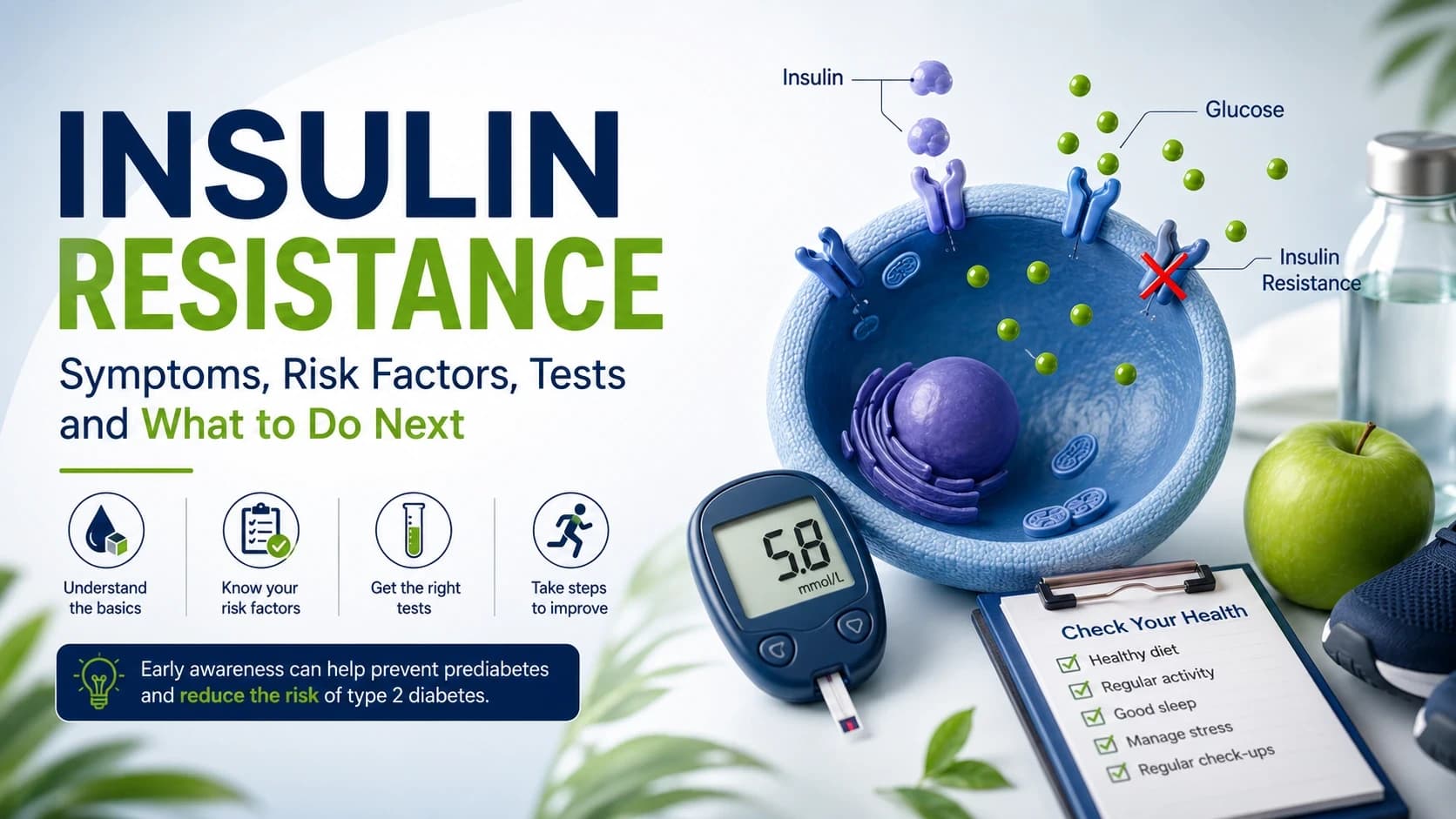
The ICMR-INDIAB study of 113,043 adults found prediabetes in 15.3% of adults in India, using WHO criteria12. Prediabetes is not one condition. Its two main forms fail in different places and overlap only partly2:
| Feature | Impaired fasting glucose (IFG) | Impaired glucose tolerance (IGT) |
|---|---|---|
| Main site of insulin resistance | Liver (severe) | Skeletal muscle (marked) |
| Muscle insulin sensitivity | Normal or near normal | Reduced |
| Liver insulin sensitivity | Severely reduced | Mildly reduced |
| Early-phase insulin release | Reduced | Reduced |
| Late-phase insulin release | Not described as impaired | Impaired |
| Glucose that rises | Fasting glucose | Glucose 2 hours after a glucose load |
Four things go wrong, and each makes the next worse:
- The liver over-produces glucose. In IFG the liver responds poorly to insulin's signal to slow glucose release, so fasting glucose drifts upward2. Raised fatty acids increase the liver's glucose-making enzymes, and raised glucose increases G6Pase, the enzyme that releases glucose from the liver3.
- The early insulin burst weakens. Both forms show a smaller first-phase insulin response2. Without it, the liver keeps releasing glucose after a meal10, so glucose from food and glucose from the liver enter the blood together.
- Muscle clears glucose slowly. In IGT, muscle insulin resistance and a weaker late-phase insulin response slow glucose clearance, so glucose stays high for longer after meals2.
- The beta cells come under strain. Raised glucose and raised free fatty acids each impair insulin secretion, effects known as glucotoxicity and lipotoxicity3. People in the upper third of the IGT range are close to maximally insulin resistant and have lost more than 80% of their beta-cell function3.
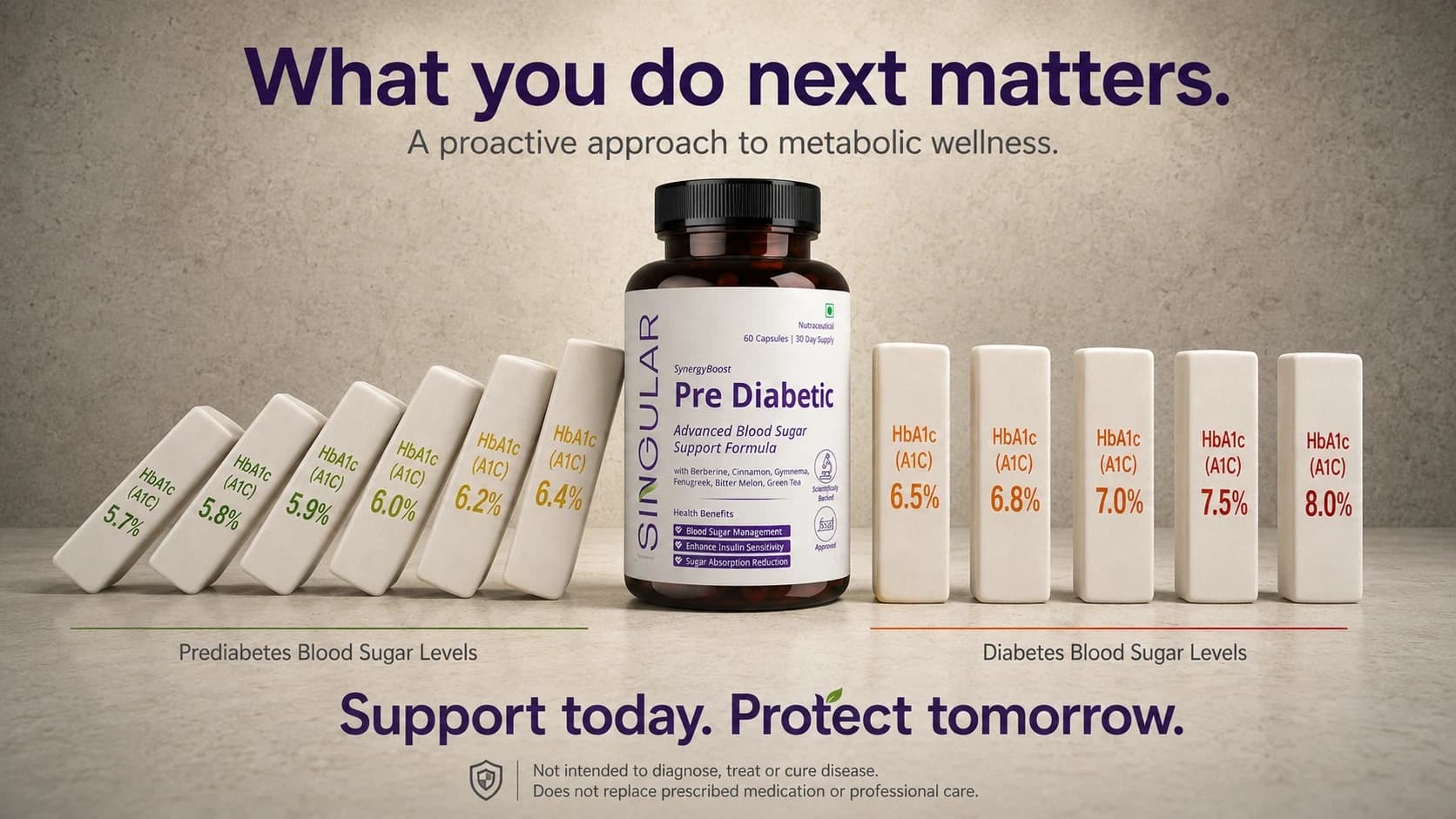
Prediabetes can still move in either direction. Each year, 5–10% of people with prediabetes progress to type 2 diabetes, and a similar share return to normal glucose13. In one model of beta-cell decline, the stage at glucose levels of about 5.0–6.5 mmol/L involves lost beta-cell mass and function but can still reverse14. DeFronzo's analysis argues that treatment should start early, to slow the beta-cell failure already present in IGT3.
Where Each Ingredient Acts
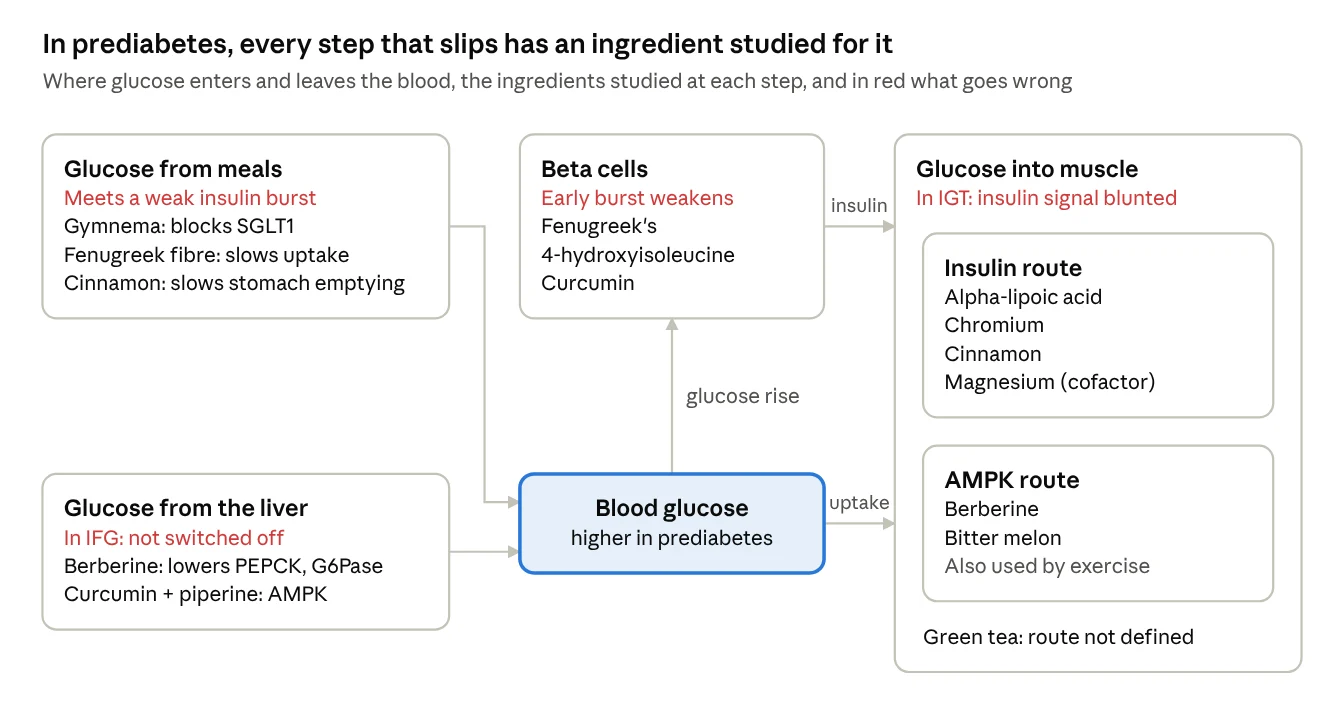
Glucose enters the blood from meals and from the liver, and leaves it mainly into muscle; each box lists the ingredients studied at that step, with the step-by-step evidence below.
Step by Step: How Each Ingredient Is Thought to Act
Amounts are per two-capsule serving, from the label1. Standardisation figures are Singular's manufacturer specifications and are not printed on the label.
Step 1: Slowing Glucose Arrival From Meals
Slowing absorption works without insulin. It shrinks the wave of glucose that a weak early insulin response and insulin-resistant muscle have to handle2.
- Gymnema (167 mg, 75% gymnemic acids). Gymnema saponins strongly blocked SGLT1 in a laboratory model; one was about as potent as phlorizin, a reference SGLT1 blocker9. Human trials have mostly been in type 2 diabetes and vary in quality15.
- Fenugreek (150 mg, 50% 4-hydroxyisoleucine). Fenugreek seed's viscous fibre, galactomannan, reduced glucose uptake in rat intestine in proportion to its viscosity16. Singular's extract is standardised to 4-hydroxyisoleucine rather than fibre, so its main action is expected at Step 2.
- Cinnamon (175 mg, 5% cinnamaldehyde). In healthy adults, 6 g of ground cinnamon taken with rice pudding slowed stomach emptying and lowered the post-meal glucose rise17. In a 12-week trial in adults with prediabetes, cinnamon capsules three times daily kept fasting glucose stable while it rose on placebo18.
Step 2: Supporting the Early Insulin Response
- Fenugreek's 4-hydroxyisoleucine (about 75 mg). In isolated rat and human islets, it increased glucose-stimulated insulin release only when glucose was above normal, with no effect at 3 or 5 mmol/L19. In insulin-resistant rats it also activated early insulin signalling in liver and muscle20. This glucose-dependent action suits the weak post-meal insulin response in prediabetes, but it has not been measured in people. The strongest human fenugreek evidence is a 3-year trial in 140 adults with prediabetes, using 5 g of seed powder twice daily: people in the control group were 4.2 times more likely to develop diabetes21.
Step 3: Restraining Glucose Release From the Liver
- Berberine (225 mg, 97% berberine hydrochloride). In diet-induced diabetic rats, berberine lowered fasting glucose and reduced the liver enzymes PEPCK and G6Pase, independently of insulin signalling22.
- Curcumin (125 mg turmeric extract, 95% curcuminoids) with piperine (10 mg, 95% piperine). In rat and human liver cells, curcuminoids activated AMPK and suppressed PEPCK and G6Pase, but did not directly raise glucose uptake into muscle cells23. In a 9-month trial in 240 adults with prediabetes, 16.4% of the placebo group developed type 2 diabetes, against none of those taking 1,500 mg of curcuminoids daily without piperine24. Piperine is included because curcumin is poorly absorbed: 20 mg of piperine raised curcumin bioavailability 20-fold in volunteers taking 2 g of curcumin6.
Step 4: Moving Glucose Into Muscle
Seven ingredients have been studied at this step. Some act on the blunted insulin signal itself; others use AMPK, the energy-sensing signal that exercise also uses.
Insulin route
- Alpha-lipoic acid (100 mg). In muscle cells it moved GLUT1 and GLUT4 transporters to the surface, and blocking PI3-kinase abolished the effect25. In type 2 diabetes, oral doses of 600–1,800 mg daily for 4 weeks raised insulin-stimulated glucose clearance by 27% compared with placebo26.
- Chromium picolinate (200 mcg). In insulin-resistant muscle cells it restored insulin-stimulated GLUT4 movement, an effect that depended on AMPK27. In people at risk of diabetes, 500 or 1,000 mcg daily for 6 months did not change glucose or insulin sensitivity28, so chromium is best seen as a supporting nutrient.
- Cinnamon. A cinnamon polymer acted like insulin in fat cells and triggered phosphorylation of the insulin receptor29.
- Magnesium (166 mg magnesium oxide, about 100 mg magnesium). The insulin receptor needs magnesium for its tyrosine-kinase activity, and low cell magnesium worsens insulin resistance7. In adults with prediabetes and low blood magnesium, 382 mg of magnesium daily (as magnesium chloride) for 4 months improved glucose status in 50.8% of people, against 7.0% on placebo30.
AMPK route
- Berberine. In muscle cells it activated AMPK and moved GLUT4 through a route independent of PI3-kinase31, by mildly inhibiting mitochondrial complex I, a mechanism it shares with metformin32. In a 12-week pilot trial in 34 adults with prediabetes, a 97% berberine hydrochloride extract at 1,500 mg a day lowered HbA1c from 6.40% to 5.43%33.
- Bitter melon (125 mg, 10% charantin). Bitter melon triterpenoids activated AMPK, moved GLUT4 in muscle and fat cells, and improved glucose disposal in insulin-resistant mice34. In 52 adults with prediabetes, 2.5 g of bitter gourd powder daily for 8 weeks lowered fasting glucose by 0.31 mmol/L35.
Route not defined
- Green tea (125 mg, 50% EGCG). In diabetic rodents, green tea raised glucose uptake into muscle and moved more GLUT4 to the surface36. In people the effect is small: across 22 trials, fasting glucose was 1.48 mg/dL lower37.
Step 5: Easing the Strain on the Beta Cells
Lower post-meal peaks and less liver glucose mean less of the glucose and fatty-acid exposure that impairs beta cells3. In the curcumin prediabetes trial, beta-cell function (HOMA-β) was 61.58 on curcumin against 48.72 on placebo24, and curcuminoids lowered serum free fatty acids in type 2 diabetes38.
Garlic: Mechanism Not Settled
- Garlic (75 mg, 1% allicin). Across 9 trials in type 2 diabetes, garlic supplements lowered fasting glucose, fructosamine and HbA1c39. How garlic acts on glucose is not settled, so it is not placed at a single step.
Ingredient Summary
The table brings the steps together, in label order1. The last column names the best kind of evidence found for each ingredient's role here:
| Ingredient | Per serving (label) | Standardised to (manufacturer specification) | Where it acts | Mechanism studied | Best evidence for this role |
|---|---|---|---|---|---|
| Berberine (Berberis aristata root extract) | 225 mg | 97% berberine hydrochloride | Muscle (AMPK route); liver | Activates AMPK through mitochondrial complex I; moves GLUT4; lowers PEPCK and G6Pase | 12-week pilot trial in prediabetes33 |
| Cinnamon (Cinnamomum verum bark extract) | 175 mg | 5% cinnamaldehy de | Meal; muscle (insulin route) | Slower stomach emptying; insulin-like action | 12-week trial in prediabetes18 |
| Gymnema (Gymnema sylvestre leaf extract) | 167 mg | 75% gymnemic acids | Meal | Blocks the gut glucose transporter SGLT1 | Laboratory model9 |
| Magnesium oxide | 166 mg (about 100 mg magnesium) | Mineral salt | Muscle (insulin route) | Cofactor for the insulin receptor's kinase | 4-month trial in prediabetes with low magnesium30 |
| Fenugreek (Trigonella foenum-graecum seed extract) | 150 mg | 50% 4-hydroxyisoleuc ine | Insulin response; meal | Glucose-dependent insulin release; viscous fibre | Islets and rats19, 20; 3-year trial with seed powder21 |
| Bitter melon (Momordica charantia fruit extract) | 125 mg | 10% charantin | Muscle (AMPK route) | Activates AMPK; moves GLUT4 | Mice34; 8-week trial with whole-fruit powder35 |
| Green tea (Camellia sinensis leaf extract) | 125 mg | 50% EGCG | Muscle (route not defined) | Moves GLUT4 | Rodents36; small effect in human trials37 |
| Turmeric (Curcuma longa extract) | 125 mg | 95% curcuminoids | Liver; beta cells | Activates AMPK in liver cells; lowers PEPCK and G6Pase | 9-month prevention trial in prediabetes24 |
| Alpha-lipoic acid | 100 mg | Not applicable | Muscle (insulin route) | Moves GLUT4 through PI3-kinase | 4-week oral trial in type 2 diabetes26 |
| Garlic (Allium sativum extract) | 75 mg | 1% allicin | Not settled | Not settled | Meta-analysis in type 2 diabetes39 |
| Piperine (Piper nigrum fruit extract) | 10 mg | 95% piperine | Absorption | Raises curcumin bioavailability | Human volunteers6 |
| Chromium picolinate | 200 mcg | Mineral salt | Muscle (insulin route) | Restores insulin-stimulated GLUT4 movement through AMPK | Muscle cells27; no effect in a 6-month trial in people at risk28 |
Why the Ingredients Are Combined
No single ingredient has been studied at every step, so the formulation places at least one at each. Four ideas sit behind the combination.
- Lowering the load while raising clearance. Ingredients that slow meal glucose and restrain the liver reduce how much glucose enters the blood; ingredients acting on muscle increase how much leaves it2, 8. Both sides matter because the two forms of prediabetes fail in different places2.
- Two routes into muscle. In people with type 2 diabetes, insulin-stimulated GLUT4 movement is impaired, yet a single bout of exercise raised surface GLUT4 by 74%, close to the 71% seen in healthy people5. Pairing insulin-route ingredients with AMPK-route ingredients follows the same logic, because the second group does not rely on the blunted insulin signal31, 34. In drug treatment of type 2 diabetes, combining a medicine that acts through insulin signalling with one that acts through AMPK gave an additive fall in HbA1c3; that finding concerns medicines, not this formulation.
- Liver and muscle together. Berberine is the one ingredient studied on both sides, for muscle glucose uptake31 and liver glucose production22. Curcuminoids act mainly on the liver23.
- Absorption partners. Piperine raised curcumin bioavailability 20-fold6. It also blocks P-glycoprotein40, an intestinal pump that limits berberine absorption; blocking that pump raised berberine absorption six-fold in rat intestine41. Whether piperine raises berberine levels in people has not been measured.
Researchers describe synergy as arising when the constituents of a mixture act on different targets, or when one improves the absorption of another42, and synergy is one proposed explanation for activity at low doses in herbal products43.
Studies of other combinations at modest amounts point the same way. In 62 overweight adults with prediabetes, a supplement with cinnamon extract, chromium and carnosine lowered fasting glucose over 4 months compared with placebo, without changing HbA1c44. In 100 people with type 2 diabetes, curcuminoids 500 mg with piperine 5 mg daily for 3 months lowered glucose and HbA1c compared with placebo45.
Frequently Asked Questions
How does Singular Pre Diabetic work?
It combines ingredients studied at the four steps of glucose control that slip in prediabetes2, 3: gymnema, fenugreek and cinnamon at glucose arrival from meals; fenugreek's 4-hydroxyisoleucine at the early insulin response; berberine and curcumin at liver glucose release; and alpha-lipoic acid, chromium, cinnamon, magnesium, berberine, bitter melon and green tea at muscle uptake.
Is Singular Pre Diabetic a glucose disposal agent?
Partly. Strictly, glucose disposal means glucose leaving the blood for the tissues, mostly skeletal muscle8, and seven of its ingredients have been studied at that step. The others act on glucose appearance instead, by slowing absorption from meals or restraining the liver. "Glucose disposal agent" is a sports-nutrition term, not a medical or regulatory category.
Does berberine work like metformin?
Berberine activates AMPK by mildly inhibiting mitochondrial complex I, a mechanism it shares with metformin32. In a 3-month pilot trial in newly diagnosed type 2 diabetes, berberine 0.5 g three times daily lowered glucose about as much as metformin at the same dose46. That does not make it a substitute: Singular Pre Diabetic is a nutraceutical, not a medicine, and provides about 218 mg of berberine hydrochloride a day.
Why does the formula contain piperine?
Curcumin is poorly absorbed, and piperine raised its bioavailability 20-fold in human volunteers6. Piperine also inhibits P-glycoprotein and the liver enzyme CYP3A440, which may raise blood levels of berberine41 and of some medicines.
Can it be taken with glucose-lowering medicines?
Only with your doctor's guidance. Berberine combined with glucose-lowering medicines lowered glucose more than either alone47, so glucose could fall too low. Two weeks of berberine reduced the activity of the liver enzymes CYP2D6, CYP2C9 and CYP3A4 in healthy men48, and piperine inhibits P-glycoprotein and CYP3A440; both effects can raise blood levels of some medicines.
Who should check with a doctor before taking it?
The label advises consulting a healthcare provider first if you are pregnant, nursing, taking medication or have a medical condition, and the product is for adults only1. Berberine displaces bilirubin from albumin, and its authors advise avoiding berberine-rich products in pregnancy and in jaundiced newborns49. Alpha-lipoic acid can rarely trigger insulin autoimmune syndrome, which causes recurrent low blood glucose50, and rare liver injury has been linked to high-dose, high-bioavailability turmeric products51.
Does it replace diet and exercise?
No. In the US Diabetes Prevention Program, a lifestyle programme cut new diabetes by 58% over 2.8 years, and metformin by 31%52. In the Indian Diabetes Prevention Programme, lifestyle change reduced the risk by 28.5% in Asian Indians with impaired glucose tolerance53. Exercise also moves GLUT4 into muscle without relying on insulin4, 5.
Every published reference below was checked on PubMed on 21 October 2026. Reference 1 is Singular's own product documentation.
This article is for education and does not replace medical advice. Singular Pre Diabetic is a nutraceutical and is not intended for medical use.